Physical Address
304 North Cardinal St.
Dorchester Center, MA 02124
Physical Address
304 North Cardinal St.
Dorchester Center, MA 02124

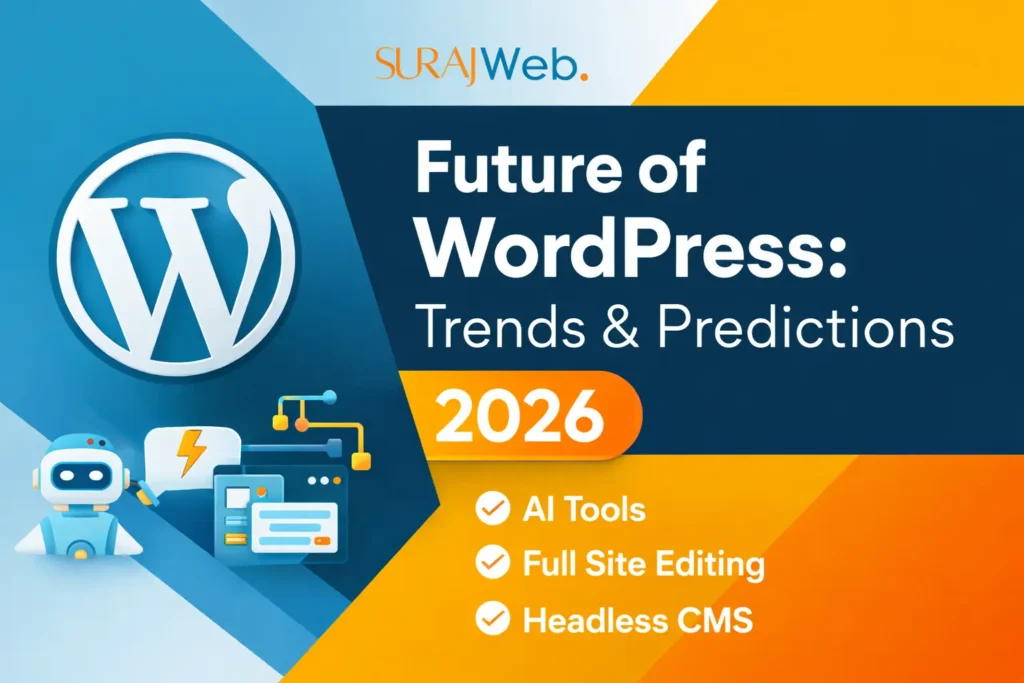
WordPress has already proven itself as the backbone of the web, powering over 40% of all websites globally. But as we move into 2026, the platform is evolving rapidly—driven by AI, performance demands, and modern user expectations.
If you’re a developer, freelancer, or business owner (like SurajWeb), understanding these trends is critical to staying ahead.
Artificial Intelligence is no longer optional—it’s becoming core to how WordPress works.
👉 Prediction:
By 2026, most WordPress websites will have AI-assisted workflows, reducing manual effort by 40–60%.
The shift from classic themes to block-based themes is accelerating.
👉 Prediction:
Classic themes will become obsolete, and FSE will become the default standard.
Headless architecture separates the frontend from the backend.
👉 Prediction:
Agencies and advanced developers will adopt Headless WordPress for high-performance projects.
Google ranking now heavily depends on performance metrics.
👉 Prediction:
Slow websites will lose traffic and rankings, forcing developers to prioritize performance-first builds.
Cyber threats are increasing, and WordPress is a common target.
👉 Prediction:
Security will become a core feature, not an add-on.
WooCommerce continues to grow as a powerful eCommerce solution.
👉 Prediction:
WooCommerce will compete more strongly with platforms like Shopify, especially in customization-heavy stores.
Users expect websites to behave like apps.
👉 Prediction:
Websites that are not optimized for mobile will struggle to survive.
Plugins will become more intelligent and optimized.
👉 Prediction:
The “install 20 plugins” approach will die—quality over quantity will win.
WordPress is becoming more accessible to non-developers.
👉 Prediction:
Even beginners will be able to create professional websites without coding.
Design is evolving toward simplicity and speed.
👉 Prediction:
Clean, fast, and user-focused design will outperform flashy, heavy designs.
WordPress in 2026 is not just a CMS—it’s becoming a complete digital experience platform.
✔ AI will automate most tasks
✔ Full Site Editing will replace old themes
✔ Performance & speed will decide success
✔ Headless WordPress will grow fast
✔ Security & privacy will be critical
If you want to stay ahead as a freelancer:
The future of WordPress is faster, smarter, and more automated.
Those who adapt early will dominate the market, while others will struggle to keep up.
👉 2026 is not about just building websites—it’s about building smart, scalable digital experiences.